15 March 2026
Building an agency group through acquisition: where to start
Agency growth through acquisition demands preparation. This piece provides a strategic framework covering acquisition rationale, target criteria, pipeline building, deal structuring and integration, drawn from real-world experience completing eleven agency deals across the Creative, Performance Marketing, and PR sectors.
Every ambitious agency owner reaches a point where organic growth alone feels too slow. You look at the holding companies, the PE-backed groups, the independents who seem to be scaling at pace, and you think: acquisition is the answer. And you might be right. But wanting to grow through M&A and knowing how to do it are different things.
Key Takeaways:
Strategic Rationale - know your why: Define whether you are buying for scale, capabilities, or geography before looking at targets.
Target Criteria: Avoid 'deal fever' by setting non-negotiable financial and cultural benchmarks early.
Pipeline Discipline: Build a direct outreach engine rather than relying solely on broker-led processes.
Deal Structure: Use earn-outs and equity alignment to ensure founders remain motivated post-acquisition.
Integration First: Success is defined by the first 100 days of cultural and operational alignment, not the deal signing.
I have been on both sides of this. I had my own business acquired (badly, as it happens), and then went on to build Selbey Anderson, where we completed eleven agency deals across sectors including Creative, Performance Marketing, Digital Transformation, and B2B PR. I have seen what works and what doesn't.ted 11 (or 13 depending on who you talk to) acquisitions in 30 months and grew the group to over £20m in revenue. Along the way, I learned that the difference between successful acquirers and those who stumble is rarely about money or ambition, it is about preparation, process and discipline.
So, if you are serious about building an agency group through acquisition, here’s where you should start.
Be Clear About Why and What you Are Buying
This sounds obvious, but it’s the step people skip. It’s boring isn’t it? You see a deal, get excited and try to make it work. That’s back-to-front. Before you look at even one target, you need to be absolutely clear about the why.
Are you buying capacity or capability? Are you adding a capability your clients are asking for? Are you buying revenue to hit a scale threshold that makes your group attractive to a future buyer? Are you buying to enter a new geography? Are you buying talent you can’t recruit? Are you buying certification or a way into a vendor ecosystem?
Any of these can be valid reasons to acquire, but each one leads to a completely different type of acquisition. A capability buy might be a small, specialist shop with deep expertise. A scale play might be a generalist agency with solid recurring revenue. A talent acquisition might be a tiny team with an outsized reputation. If you don’t know what you are solving for, you could waste months chasing the wrong deals.
So, know what you want, distil your thinking, then write it down on one page.
What does your group look like in three years, and what role does acquisition play in getting there? That single page becomes the filter through which every opportunity must pass.
Define Your Acquisition Criteria
Once your why is clear, you can focus on the what and build your acquisition criteria or ‘buy box’. Think of this as your shopping list. Be specific. Vague criteria lead to vague pipelines, and vague pipelines lead to wasted time and bad deals.
Your criteria should cover several dimensions.
Start with size. What revenue range are you targeting? Too small and the integration effort outweighs the benefit. Too large and you may struggle to fund the deal or digest the business. For most independent agency groups building through acquisition for the first time, targets in the £1m to £3m revenue range tend to be the sweet spot. They are meaningful enough to move the needle and manageable enough to integrate.
Then, think about sector focus, service capability, client concentration, team structure and geography.
Consider culture, too. Culture mismatch is the silent killer of agency acquisitions. Two agencies can look perfect on paper and be completely incompatible in practice. You need to think about what kind of agencies will thrive within your group and which ones will resist the things you’ve put in place to make your model work.
The sharper your criteria, the faster you can qualify or disqualify opportunities and speed matters, because your time is your scarcest resource.
Build a Pipeline Before You Need One
Most agency owners approach M&A reactively.
A broker calls, a founder mentions they are thinking of selling, a mutual contact makes an introduction. And you know, these opportunistic deals can work, but relying on them alone is a recipe for frustration and loss. You end up looking at whatever happens to come along rather than what you need.
The best acquirers build a pipeline proactively. They identify target agencies that fit their criteria and begin building relationships long before a transaction is on the table. This is about becoming visible in the right circles, building a network contributing to conversations about the future of the industry, and positioning yourself as someone who understands what agency owners care about. Cold-calling agency founders and asking if they want to sell feels like progress, but it’s the approach of a busy fool.
So, you start by mapping your market.
Identify every agency that fits your criteria within your target geography and sector. Use directories, award lists, industry publications and your own network. Build a longlist, then research each one. Who are the founders? How long have they been running the business? What is their likely succession plan? Are there signals that they might be open to a conversation?
From that longlist, create a shortlist of priority targets. These are the agencies you want to build genuine relationships with over time. Attend the same events. Find out who you know in common. Comment thoughtfully on their work. Find reasons to collaborate. The goal is that when the time comes for them to think about their next chapter, you are already in the conversation. As marketers, you know all about this. It’s called building mental availability and salience.
This kind of pipeline takes months to build, which is exactly why you need to start before you are ready to buy.
Structure Your Approach
When you do approach a target, how you do it matters enormously.
Agency founders are not selling widgets. They are selling something they built from nothing, something that carries their name, their reputation and their relationships. It’s a business filled with people to whom they have made promises. They want to see those promises kept.
Top tip: The emotional dimension of agency M&A is significant, and anyone who ignores it will struggle to get deals across the line.
Lead with curiosity, never lead with an offer. Your first conversation should be about understanding their business, their ambitions and their concerns. What do they want for their team? What do they want for their clients? What do they want for themselves? Listen more than you talk. If you have done your homework and built your relationship well, this conversation will feel natural rather than transactional.
Only when you have a genuine understanding of what the seller wants should you begin to outline what a deal might look like. And at this stage, keep it simple. Heads of terms do not need to be fifty pages. Mine are four or five. The clue’s in the name. It’s called a head of terms, not an exhaustive list of terms. A clear, fair structure that addresses the seller's key concerns will get you further than a complex earn-out mechanism that requires a spreadsheet to understand.
The structure of your deal should reflect your why. If you are buying for capability, you need the key people to stay and be motivated. That means retention structures, earn-outs tied to achievable targets, and a clear role for the founders within the group. If you are buying for scale, the emphasis shifts to operational integration and cost synergies. Match the deal to the strategy.
Do Not Underestimate Integration
Signing the deal is the start line, not the finish. Integration is where value is created or destroyed, and it is where most first-time acquirers come unstuck.
Have an integration plan before you complete the deal. Know which systems you are going to consolidate, which processes you are going to align, and which things you are going to leave alone. Be deliberate about what you centralise and what you leave with the acquired business. Over-integrate too quickly and you risk destroying the very thing you bought. Under-integrate and you end up running a collection of separate businesses rather than a group, which defeats the purpose.
Communication is everything during integration. The team at the acquired agency will be nervous. They will have questions about their jobs, their clients, their culture and their future. Address those questions early, honestly and often. The founders you bought the business from are your best allies in this process, so invest in that relationship.
Get Help From People Who Have Done It
Agency M&A is not something you can learn entirely from a book or a blog post, mine included. The nuances of deal origination, negotiation, due diligence and integration are best understood through experience, and ideally through the experience of people who have done it repeatedly.
This is precisely why, with my colleagues at DAB, we created the Boston M&A Bootcamp (30 April to 1st May 2026). It was a small-group, intensive, in-person session designed specifically for agency founders and operators who want to scale through acquisition. Over two days, we worked through the exact framework I have outlined here, but in far greater depth and with hands-on exercises tailored to delagates' specific situations. Participants left with a clear acquisition strategy, defined criteria, a pipeline plan and a practical approach to deal structuring.
Start Now
The agencies that will be doing deals twelve months from now are the ones that start building their strategy, their criteria and their pipeline today. M&A rewards the prepared and it punishes the reactive. I learned that the hard way.
So, take that first step.
Write down your strategic rationale. Define your criteria. Start mapping your market. And if you want to accelerate the whole process, come to Boston at the end of April and do it with us.
The opportunity is there. The question is whether you are ready to be deliberate about seizing it?

Dom Hawes
Dealhunter
Dom Hawes is an M&A adviser focused on creative and consulting businesses. After building and scaling a multi-agency marketing services group through acquisition, he now works full time on originating, structuring, and executing deals for founders and investors. He specialises in sub £20m revenue businesses, with particular expertise in buy-and-build strategy, deal sourcing, valuation, and transaction structuring. Dom writes about mergers and acquisitions, value creation, and the realities of building and exiting services firms.
Related reading
9 March 2026
Lessons every agency seller needs to hear (Part 2)
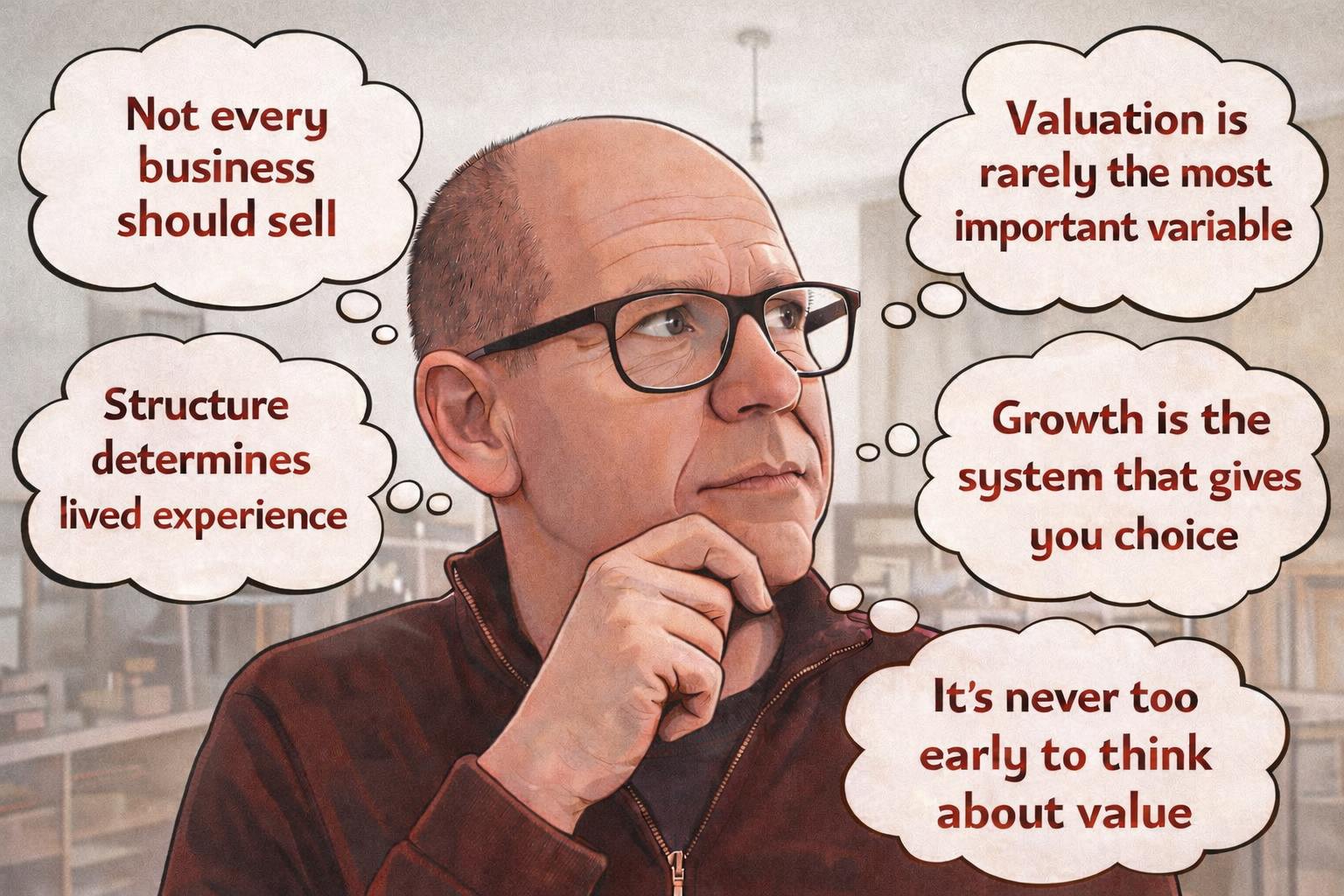
One of the most difficult lessons I’ve come to terms with in the last decade is that completing a deal is sometimes the wrong thing to do. Regardless of how good it looks on paper, and whether you’re a buyer or a seller, unless you’re absolutely clear on your motivation to complete, you probably shouldn’t.

2 March 2026
Lessons every agency seller needs to hear (Part 1)
Lessons from the sharp end. How using a buyer mindset helps you build a better agency whether you want to sell or not. This is part one of a two-part series.

23 February 2026
Why I keep telling agency owners not to sell
Since 2022, the market for creative agencies has been brutal. Margins are compressed, clients have churned, and most owners are exhausted. They want out. But wanting out and being ready to sell are two very different things.