29 September 2026
Post-merger integration for agencies: the playbook that decides whether your acquisition pays
Buying an agency is the easy part. Integration decides whether one plus one makes three. This playbook covers the phases, workstreams, governance and measures that protect the multiple you paid.
Value isn't created or realised simply by acquiring another agency. Buying another business is the easy bit if you have the right advisors. It's what you do post-acquisition that decides whether one plus one equals three.
Integration is where M&A succeeds or fails. Harvard Business Review has put the failure rate of acquisitions at somewhere between 70% and 90% ( Christensen et al, "The Big Idea: The New M&A Playbook", HBR, March 2011). Even if the truth is half that, the odds are against you.
As someone who has both led a buy-and-build and sold agencies into groups, I have real, first-hand experience of integration. I wish I could report that my own execution had been flawless. Sadly, it wasn't. But, that's how lessons are learned. Experience. It's why I started Hunter Hawes & Co, and it's why we're different from most M&A advisors. We've done this as principals, not just advised on it.
This playbook sets out how buyers of sub-£5m creative, brand and communications agencies should plan, sequence and govern integration. It covers the phases running from pre-deal work through the early months, the workstreams that matter most in a people-based business, and the measures that tell you whether the acquisition is genuinely working.
Who has the time for that?
This is how things often play out. Agency buyers spend months of intensive activity on the deal. Due diligence is slow, expensive and time sapping. So, when the deal is finally signed, the champagne corks pop and everyone breathes a sigh of relief.
So, you bought or merged with another agency? Congratulations!
What next?
Agency leads often hand integration to whoever has spare capacity, regardless of their experience of integration. This can be an exceedingly expensive mistake. Post-merger integration is where the multiple you paid is realised or written down. In a small agency of fifteen to fifty people the damage shows up within the first quarter as client churn, staff exits, falling adjusted EBITDA or all of the above.
Whether yours is an acquisition or a merger, pick your integration lead very carefully. Simply having the time is not the qualification you're looking for.
What post-merger integration means for an agency buyer
"Post-merger integration is the process of combining two businesses into one after a deal completes, so the assets, people, customers and systems that justified the price are kept and made to work together." That's the textbook definition and it's true as far as it goes.
But, it was written for asset-heavy businesses like manufacturers. When an industrial buyer integrates, it merges plant, systems and logistics. When you buy an agency, you merge clients, people, contracts, supplier relationships and culture. It's different.
A more appropriate definition for creative firms is this: post-merger integration is the planned process of combining two agencies after a deal completes, so the brand, clients, people, systems, creative capability and cash flows that justified the price stay intact and start working together.
That difference might seem semantic, but it's important. An agency has almost no physical assets to consolidate and very few hard cost lines to strip out. The value you paid for sits in relationships and they can disappear quickly. So, agency integration is less about restructuring and more about retention, culture and clarity. Get the sequencing wrong and you risk losing the very thing you bought. I know that from first-hand experience.
Integration starts before completion, not after
If you're putting off integration planning until the deal is signed, you're already behind.
Post-merger integration must start in the early phases of the M&A lifecycle. Synergies get identified, risks get assessed and governance gets set up before completion. Why so early? Because the decisions that decide the outcome, like who leads the combined business and which systems survive, need to be made while you still have leverage and information. After completion you have neither.
For an agency acquisition or merger, the pre-completion window should produce three documents:
An integration thesis. One page explaining why these two businesses are worth more together than apart.
A synergy register. Every synergy with a named owner and a value against it.
A decision log and plan. The choices that can't wait for Day 1, a list of actions, and the criteria that will define whether the integration has succeeded.
Here's a test. If you can't write the integration thesis in a paragraph, your synergy numbers are guesswork. I've seen buyers pay a multiple on guesswork and it doesn't end well.
The misperception that destroys deal value
Earlier I said don't hand integration to whoever has spare time. Now I'll tell you why it costs so much when you do.
Integration is a project. It has dependencies, deadlines and competing priorities. In an agency, it will lose every single time to a client deadline or a pitch, unless somebody owns it as their main job. Nobody chooses the integration workstream over a live pitch. They shouldn't. That's exactly why integration needs its own owner.
So who is the owner? Not you, or at least not day-to-day. As the leader you're accountable for the outcome, but you're also holding the biggest client relationships and you can't do both. The day-to-day owner is your COO, or an interim or advisor you bring in for the job. If nobody in the business has done an integration before, please get some help. The stakes are too high to busk it.
What happens when nobody owns it
A real example springs to mind.
Two agencies with complementary client bases offered different services. The integration thesis was solid. Bringing them together would let us grow every existing client through cross-sell and upsell, and the combination would be unique in the market, giving the new agency a distinctive proposition. Clear positioning is my number one leading indicator for agency success, so on paper this looked good.
Synergy register? Nope. I assumed the two agency leaders would see the synergies between them and integrate the agencies effectively. Both were seriously bright and highly experienced, just not in M&A. That was my first mistake.
Decision log? Nope. Both leaders were consulted but nothing was committed to paper. Second mistake.
Let me tell you how that worked out.
Twelve months after the integration date the two teams were still sitting as two teams, albeit in one building. The agency didn't adopt a new name and relaunch. It didn't follow through on the new positioning. It just sputtered on. There was no client cross-sell or upsell. Revenues stayed flat. By any measure this was not a success. The combined entity ended up the same size and shape as one of the old agencies. The other one just disappeared.
This is not an uncommon outcome. Treat it as a cautionary tale.
Disciplined execution is the answer. What is disciplined execution worth? BCG reports that its post-merger integration framework has helped clients capture 9% more value from their M&A deals. If you're spending £2m buying another agency, that 9% is worth £180,000 of upside. Your risk on the downside is much larger. If the combined EBITDA slides 20% after completion, then at the multiple you paid you've lost £400,000 of value. It pays to get some help. If you don't want to hire a full-time or interim integration lead, hire an advisor.
An integration playbook in four phases
The four phases below aren't tied to calendar dates, they're gates. Clear one before you start the next, and don't let anyone talk you into running them in parallel to save time. It doesn't save time.
Phase one: pre-deal integration thesis and synergy register
Write the case for the combination down. Where does revenue improve? Where does cost come out? Where does the risk sit? Then assess cultural fit honestly, and by honestly I mean look at how the two leadership teams make decisions and handle client conflict, not whether they get on at dinner. Set up the governance that will run the integration: a named integration lead and a steering group with people from both sides.
Phase two: Day 1 readiness
Day 1 is a communications and continuity exercise, nothing more. Staff need to know who they report to. Clients need to know their contacts haven't changed. Suppliers and contractors need to know who signs. Anything left unresolved on Day 1 becomes a distraction that lasts weeks. So, write the announcements, the reporting lines and the client messages before completion, then run them on a schedule. A schedule, not a scramble.
Phase three: the early months
This is where the synergy work actually happens, and the order matters.
Start with the back office: finance, HR and the essentials of IT and cyber security. Finance comes first within that, because clean numbers sit underneath every other decision you'll make. You'll be tempted to start with the front of house instead: strategy, creative and account management. I would urge you not to. By all means have a plan for them, but let the client-sensitive parts of the business settle into a rhythm first. Put them in the same office, let them work alongside each other, and let them get to know each other before you change how they work.
Then deal with the client-facing and operational overlaps. Expect the unexpected. Integration projects succeed on readiness throughout, not on how elegant the original plan looked. Keep a live issues log and review it every week.
Phase four: the second wave
Integration doesn't end when the org chart settles. Specialist PMI consultants are typically engaged to help buyers realise a deal's potential well beyond Day 1, which tells you something about how long value capture really takes. Plan for a second wave covering systems, proposition and cross-selling once the basics are stable.
The four essential workstreams in an agency deal
The phases tell you when. The workstreams tell you what. Agency integrations are won or lost across four areas, and each one needs an owner and a small set of measures.
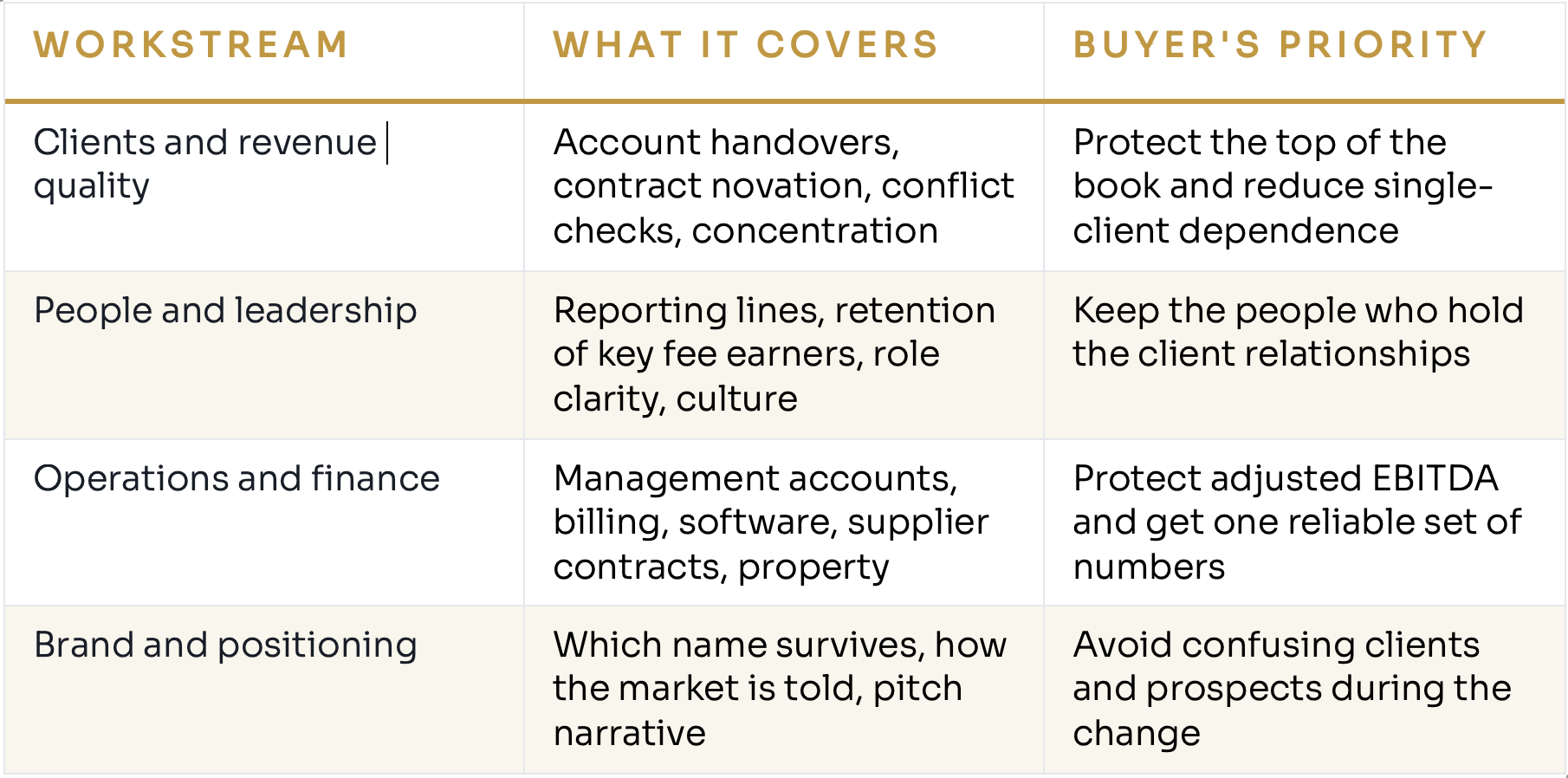
On client concentration, we apply a working threshold in our own advisory work: no single client above 18% of net revenue, and the top three combined below 50%. An acquisition can push a group through those limits in a single afternoon, so calculate the combined position before completion, not after.
Governance: who actually owns the integration?
Simple answer, one accountable lead. That person has the authority to make decisions and escalate, and that person isn't running a client portfolio at the same time.
Around them, a steering group of three to five people drawn from both businesses, meeting on a fixed rhythm with a standing agenda: synergy progress, client risk, people risk and open decisions. That's it. Avoid large committees. In an agency of thirty people, a committee of ten is a paralysis device not good governance.
Revenue synergies versus cost synergies
Cost synergies in agency deals are smaller than buyers assume. Duplicated back-office roles, software subscriptions, insurance and property are the realistic lines. Cut deeper than that into delivery capacity and you damage the revenue you paid for.
Revenue synergies are bigger in theory but slower and less certain: cross-selling to each other's clients, filling a capability gap, and pitching for work neither agency could win alone.
Post-merger integration carries both economic benefits and costs, and a credible synergy register states both. It separates one-off integration costs from recurring savings. And, it's clear about which revenue synergies depend on people who might leave.
Common failure modes to design out
Everything above exists to stop one of these seven things happening:
Integration happens in name only. The two agencies carry on as before in one office, under one name, with no meaningful effort to combine.
Integration is treated as an add-on to someone's day job, so it never gets the attention it needs and the work is pushed into the long grass.
Synergy owners are not named, so nobody takes responsibility and the savings and revenue targets go unclaimed.
Day 1 communications are left too late, creating uncertainty for clients and staff.
Culture is dismissed as a soft issue. It stays that way until the first senior resignation, by which time it's too late. Others follow.
Systems and reporting are merged too slowly, so the buyer can't see whether performance is improving or declining.
Sequencing tries to change everything at once and stalls on every front.
Using AI to build the integration plan
AI and automation are changing how quickly integration plans can be built. BCG X has developed an AI-enabled platform, Post-Merger Integration Ignite, which helps big companies construct integration and synergy plans at speed. For smaller businesses, BCG isn't an option. But Perplexity, Claude and ChatGPT can tackle the heavy lift and produce an outline for structure and tracking. They'll never replace judgement about which clients, people and propositions are worth keeping. That judgement remains yours. But they can help you make the plan.
How to measure whether integration worked
If you've followed the advice above, the measurement criteria are already in place. Judge the integration against the thesis you wrote before completion. It's tempting to use busyness as a metric, but busyness doesn't pay the bills. Value created from executing the plan does.
I recommend you track four things: client retention across the combined book, retention of the fee earners you flagged as critical, progress against the synergy register, and the quality of your management information.
A merged agency that keeps its clients, keeps its key people and runs on one clean set of accounts has done the hard part. After that, everything else is tidying up.
I said at the start that buying an agency is the easy bit. It is. The multiple you paid was a bet that one plus one would make three. Integration is where you find out whether you were right.
Feedback from LinkedIn
After posting an abridged version of this article on LinkedIn I received some excellent additions from the network. They were that useful, that I thought they needed adding to this article. I am very grateful to both Chris and Miranda for their insight.
From Chris Paton, Founder and Managing Director of Quirk Solutions:
Have an intentional focus on integrating people at the sharp end. Synergy committees, and leadership dashboards are great, but the thing that takes time is individuals getting to know one another and build trust. You can wait for this to happen naturally, as they work together, but if you want quicker implementation, deliberate and planned forming/storming/norming is essential.
Speak to people from day one about their aspirations and concerns. That helps identify quick wins that keep implementation momentum high.
Regular CEO presence is critical Post deal. We are tribal animals and everyone looks to their new CEO. If that individual delivers a rousing speech on day one, but there is then absent, cultural integration quickly drifts. The CEO should make consistent time to sit and talk to all teams and all levels.
From Miranda Gladding Dini, Founder and CEO, GOLD Strategy & Communications
Having participated in numerous acquisitions and seen successes and abysmal failures over the years, a few other things to consider as well:
Ensure that the person leading the integration (or the core integration team) knows the nuts and bolts of the client-facing realities. If they are too far removed from the day-to-day (i.e. come from finance or another back office function), their approaches will fall flat or be irrelevant to what’s actually needed and happening on the floor.
Bring the teams physically together as soon as possible. Ideally over drinks. A lot of bridges have been built over a glass of something cold.
Proactively and repeatedly provide opportunities to see what each other does in tangible ways. Present a steady pulse of case study after case study. You may think everyone understands the new business, but it’s never the case.
Discuss rates sooner than later. When bringing two agencies together and quickly pivoting to pitch or target clients together, having very different fee structures gets sticky very fast!
Communicate, communicate, communicate. There’s no such thing as too much, particularly in year 1 of integration.

Dom Hawes
Dealhunter
Dom Hawes is an M&A adviser focused on creative and consulting businesses. After building and scaling a multi-agency marketing services group through acquisition, he now works full time on originating, structuring, and executing deals for founders and investors. He specialises in sub £20m revenue businesses, with particular expertise in buy-and-build strategy, deal sourcing, valuation, and transaction structuring. Dom writes about mergers and acquisitions, value creation, and the realities of building and exiting services firms.
Related reading

21 August 2026
UK M&A Data for H1 2026: What It Means If You're Thinking About Selling Your Agency
Dealsuite publishes its UK&I M&A Monitor twice a year, drawing on survey responses from M&A advisory firms active in the £1 million to £200 million mid-market. Here's my take on it.

3 August 2026
Your EBITDA multiple isn't measuring what you think
Your EBITDA multiple is a measure of a buyer's confidence in the future, not a reward for what you've built. Understand what drives it and you'll build a higher-value agency, whether you sell or not.

27 July 2026
Help, someone wants to buy my agency
An unsolicited offer for your agency just landed, and this one you didn't delete. A former agency buyer explains how to tell a serious approach from a mail merge, and how to reply without conceding anything.