2 October 2026
Creative Agency Valuation in 2026: Adjusted EBITDA and Multiples
A multiple is a measure of buyer confidence, not a reward for effort. Here's how buyers price risk, why growth matters most, and why operations decides whether you keep the value.
Today (Friday 2nd October 2026) I am joining my friends at Supo to meet a group of agency leaders to discuss valuation multiples and what agency owners can do to impact value. I'm presenting with two other experts, Greg Caplan from Dovetail and James Kesner from Moore Kingston Smith, and it's hosted by Supo's founder, Iouri Prokhorov.
Together, I hope we'll give agency owners detailed guidance on how to derisk their agencies and build value for a bigger, better exit. Of course, not every owner wants to sell.
Just this week I met a hugely successful sales promotion business doing over £20m in revenue, and the owner has no desire to sell. He loves his business too much and hopes one of his children will take it over one day. Whether you want to sell or not, the things we're talking about today build resilience, value and a better future.
Here's an overview of what I am talking about today – what a multiple actually means and the operating system that makes an agency low-risk and therefore more sellable.
The basics of valuation
Let’s start with some basic valuation mechanics. Most valuations in the creative sector are arrived at by multiplying adjusted EBITDA by a multiple. Value = EBITDA x Multiple.
The EBITDA part of the formula is a deterministic calculation. It’s something your accountant will give you. It’s not inside the scope of this article to discuss what an adjustment is or is not, ask your accountant and they’ll tell you. All you really need to know about EBITDA is that you can improve it in two ways, you sell more or you spend less. If you can do both at the same time, you’re onto a winner.
The multiple isn’t a fixed number, but it’s set by the buyer using a process you can influence. On the basis that selling a business is ideally a competitive process (i.e. more than one buyer trying to buy the same agency), each market sector has its own range of multiples that are the norm. In the case of creative agencies under £5m, that range is normally 3x to 6x. Where you land in this range depends on how you run your business and how much a buyer wants what you have.
The multiple reframe
Multiples are subjects of myth. We’ve all heard of an agency who smashed it and sold at an eye watering multiple – 8x or higher. Sadly, some brokers too overvalue prospects to win the mandate and set expectations way beyond anything a market will pay.
One of the first things I did when moving into M&A advisory was to seek a way of explaining what the multiple is. If you don’t understand how a number is reached, how can you influence it? That is now what I call the multiple reframe, it’s how I start most of my speaker engagements. It goes like this.
The multiple is a measure of confidence.
A longer version reads: a multiple is a measure of confidence either that an acquisition will maintain or improve its business performance over the next three to five years; or that the compelling strategic objective sitting behind an acquisition will be delivered.
It’s critical you understand that a multiple has nothing to do with the years of hard work, late nights, and weekends you’ve burned. A buyer can only buy what you put in front of them – the future. While your past performance will be used to assess future potential, it’s the numbers that really tell the story to an acquirer. The numbers are supported by critical things like culture, evidence of ability, reputation, positioning, people, clients and more. But, all those things are either inputs or outputs. Cash is the outcome and that’s what sets the price. Simply, how confident can I be of outcomes from this agency in the future.
Buyers don’t like risk
As a value engineer, the reframe allows you to ask yourself a helpful question. If a multiple is a measure of confidence, what about my business might erode confidence in the future? We’re talking, of course, about building a risk register. Buyers don’t like risk, so they price it using the multiple, mitigate it using deal structures or avoid it by walking away. Understanding how a buyer sees risk is worth the effort.
But, before diving deeper into risks, due diligence and more, it might be helpful to understand the economics of an acquisition from a buyer’s point of view.
Buyer breakeven (cash-on-cash)
Assuming there aren’t large capital purchases going on (and in most agencies there aren’t), deducting tax from EBITDA gives an approximation of the free cash flow a business will produce. For example, an EBITDA of £600,000 would give, after tax, an approximate expectation of £450,000 of cash generation.
This agency, being sold at a 4.0x multiple will require £2.4m in cash. It’s unlikely that all £2.4m will be paid on completion, but let’s for a moment assume it does. If the agency isn’t growing, it will take over five years for the buyer to break even on the transaction (5 x £450k = £2.25m).
A buyer wants to break even in three to five years, so a multiple of 4x is hard to support unless either the agency is growing, or profit (and thus free cash flow) can be increased. That’s how it works. Here’s what this agency looks like.
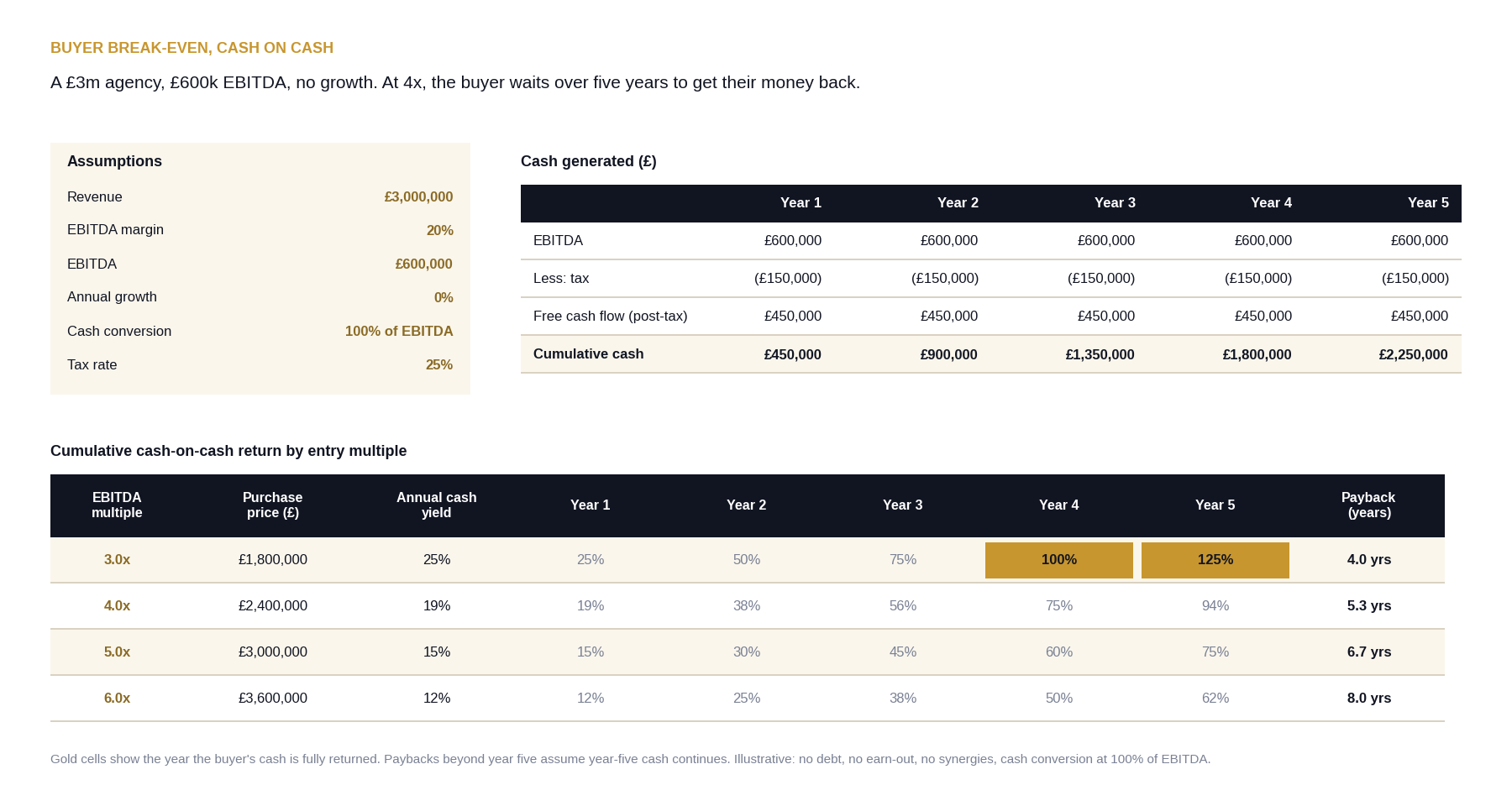
The assumptions top left mirror the numbers in the paragraph above it. The cash generation table shows how much free cash is generated and the table on the bottom shows how long the breakeven is forecasted to be. It doesn’t matter how good the agency’s outputs are. This business does not create the outcome to support a higher multiple than around three to four.
Now look at this agency. Same revenue, same profitability, but it’s growing.
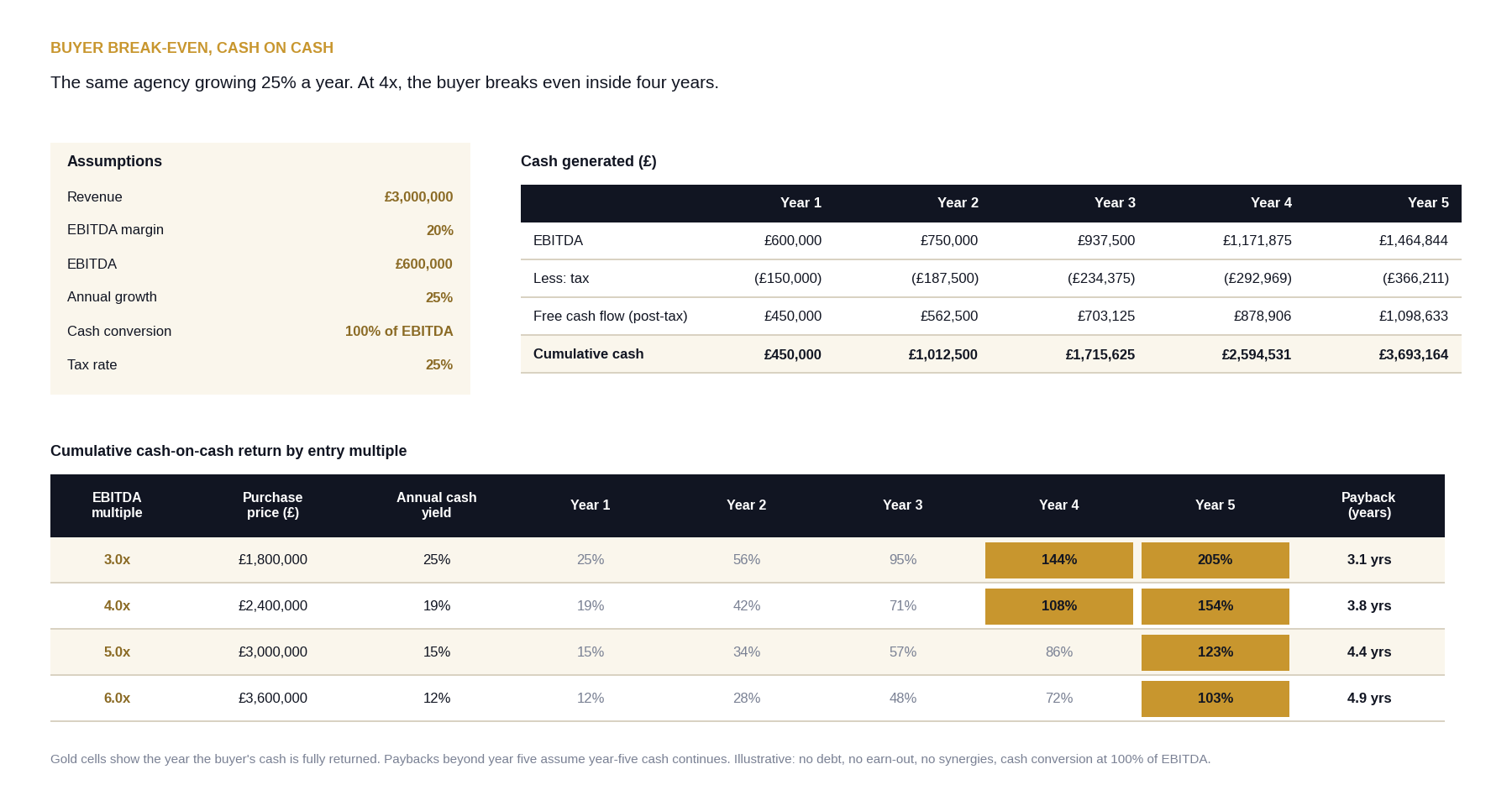
This agency probably does support a 4x multiple assuming, of course, that the risk profile of the business makes these outcomes likely. And that’s the point. How likely is the outcome to come true? Or put another way, what threatens these outcomes, and what can I see in the business that looks like a real risk?.
Very high multiples are generally reserved for very high growth companies who can scale exponentially. Agencies tend to grow in a linear and incremental way, so your multiple range is lower.
How can we get a higher multiple than our base economics can support? Earn-outs.
Why earn-outs aren’t always bad
Earn-outs don’t have a great reputation. We all know someone who walked after year one of a three-year earn-out because the founder hated being an employee, or the acquirer made it impossible to achieve the numbers. So, if they’re not liked why are they so common?
First up, if it were me buying your agency and your numbers look like the first table above (i.e. solid, but zero growth), we need a way of bridging my red line (3x) and yours (4x). Earn-outs are used to bridge valuation expectation gaps.
In this case, I can give you 4x by structuring the deal over three years, giving you growth targets for those three years and pegging your earn-out to the targets. If we work together we both win and therein lies the art of the deal. We’ll need to work together to increase cash generation by around 25% a year. Some from growth, some from synergies, some from tighter discipline – it should be possible.
But, if my red line is 3x based on current performance and your expectation is 8x, there’s a gap that’s too hard to bridge. I’ve run the numbers and you’d need to accept an earn-out target of around 75% growth every year of the earn-out. You’ll burn out before you get there.
Good earn-outs are achievable and bridge a realistic gap. Bad earn-outs promise the world, but burn out founders, then the agency flounders.
if you do nothing else, grow (profitably)
Now we have a common understanding of what the multiple is, a buyer’s dislike of risk and how valuation gaps are bridged, it’s time to dig deeper into how buyers find and measure risk. Understand this and you can shape your agency to be a low-risk acquisition and secure a better multiple.
As a buyer, I used to measure and score in excess of forty different risk dimensions in a business. When it came to selling businesses, and preparing them for the sale, I realised that number is too big. One can’t actively manage forty things at once. Well, most of us can’t. So, I codified them and grouped them into three systems.
Those systems are: growth, operations and management.
Growth brings value to the door, operations captures it and dictates how much you get to keep, management keeps the other systems working and improves the business over time.
There are four or five dimensions in each system and sub-dimensions to each of those. In this article, I’m focusing on operations (more on that in a minute), but first, I need to talk about growth.
Growth is the starting point for everything.
There are boutique agencies I’ve come across that are ideological objectors to growth. Whether they’re driven by political idealism (enough is enough and we must share), ecological idealism (growth destroys the planet and we must stop) or existential reality (I can’t grow so I object to it), the outcome is the same.
Plato observed that flatlining (or as he called it ‘ideal state’) inevitably leads to decline. A flatlining agency can survive in that state for a while, but it will eventually die just as a species that doesn’t evolve will eventually become extinct.
Growth helps you improve your team, clients, skills, technology and more. It fuels your future, it’s what your legacy is built on. It’s the single most important area of focus for you as leader. You can have the best culture in the world; the best management systems, the best operating platform and the best clients. If you’re not growing, you will lose them all. That’s why we start with growth.
If you don’t buy any of the above, this should hit home. If you’re not growing, you are actively damaging your value. I illustrated that above with the ugly Excel charts. They are ugly, but they are the truth. Grow, or accept less.
No-one started an agency to build great operations
Buyers dig deep into operational KPIs and systems because an agency’s operational infrastructure is the best predictor of sustainable success. Sadly, it’s an area often overlooked by smaller independent agencies. But, you should be clear: operations is where your enterprise value is created.
We’ve all seen agencies with brilliant positioning and a good flow of new business destroy themselves through sloppy process. The work goes out late, or over budget, or both. Margins erode or disappear completely because nobody's tracking them at a project level. Clients don't stay long. Senior people burn out and when they leave, more clients leave with them. The owner thinks it's a people problem, or a client problem, or a market problem. It's almost never any of those things. It's almost always an operations problem.
You can win every pitch on your target list, but if delivery is inconsistent, if your commercial model leaks margin, if your performance data is unreliable and your business can't hold up under scrutiny, growth accelerates the damage. I have first-hand experience of this.
I recently worked with a very well-known and multi award-winning creative agency. Their work and creativity were beyond outstanding, but their operations were not. They couldn’t get work out of the door and make money at the same time. So, when the owners told me they wanted to open in the USA, I took a breath. How can you export a model that doesn’t work? Fix the system first, then export, otherwise the bigger you get, the bigger the hole becomes. I'm not sure the owner ever accepted that, but he did the right thing anyway. He hired an MD and stepped away from the business. Great decision. The new MD is fixing the system.
Operations is the mechanism that converts talent and client trust into repeatable, measurable, transferable value. Get it right and you build a business that scales, retains and compounds. Get it wrong and you build a treadmill, one that runs faster the more successful you become.
That's why operations is the second system. Growth gets you to the table. Operations determines whether you stay there.
This what the operations system looks like. Main dimensions along the top, subdimensions under them. These are the headline operational items I look at in an agency to understand the risk to sustainable performance. I'll cover the three that do the most damage. The full set is in the operations system diagram below.
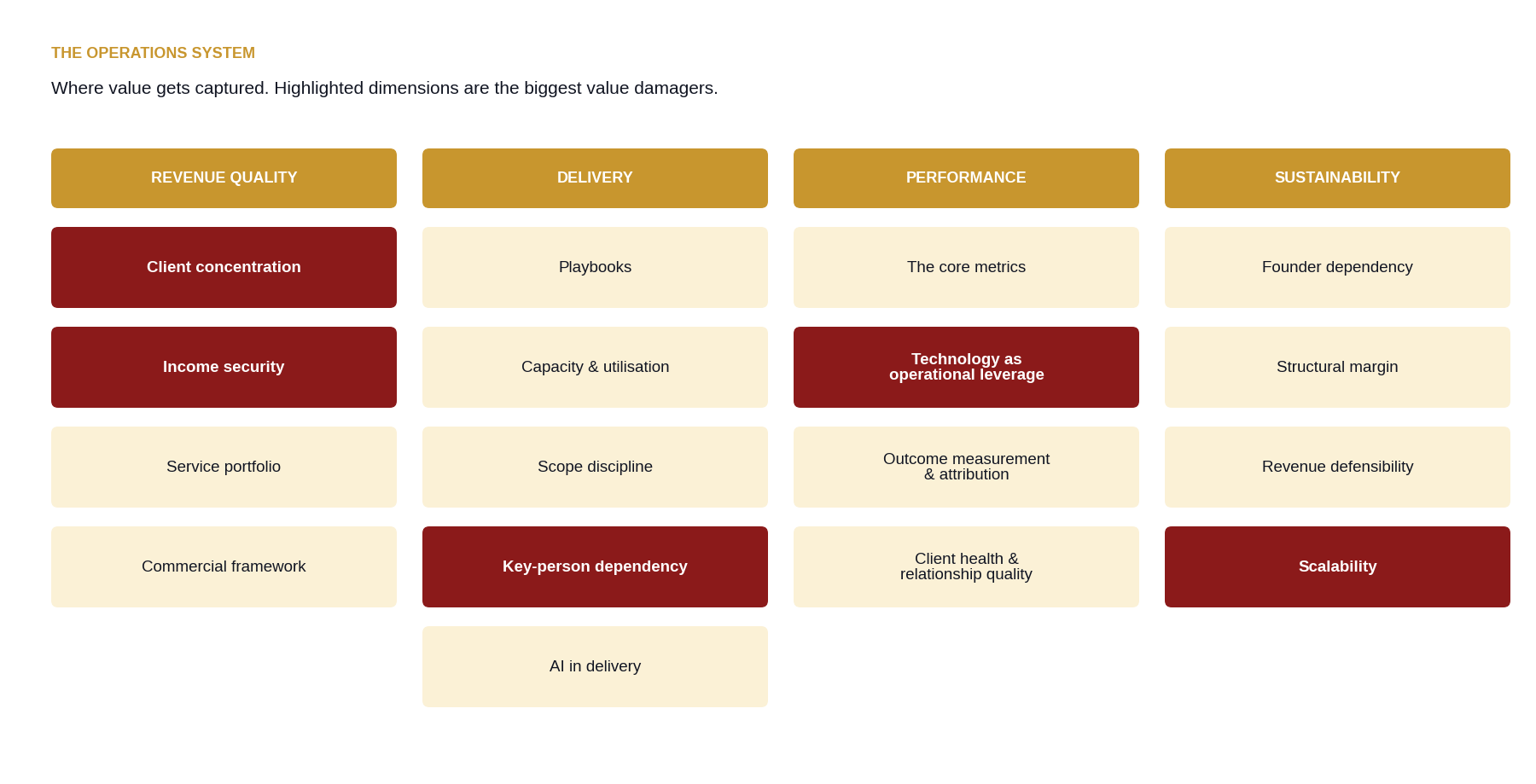
The biggest value damagers in the system (and thus your starting point as a value engineer) are client concentration, income security and key-person dependency.
Client concentration
Client concentration is the primary revenue risk metric in agency M&A. Buyers apply a concentration discount to income that's dangerously dependent on a small number of relationships. Client concentration is like kryptonite to a buyer. Avoid it at all cost, Here’s why.
A large client loves what you do. They keep giving you more and more. One day the CMO moves on and the new one fires you. That’s hard to handle. Half your team works on the account. The redundancy costs alone are impossible to meet. Your business might actually die (this isn’t apocryphal, I’ve seen it happen).
If you can't avoid concentration, devote a very healthy proportion of the added revenue from your new ‘whale’ to finding and onboarding other clients to mitigate the risk. It's tempting to send it all to the bottom line. Don't.
Income security
The traditional retainer model has largely collapsed outside of PR consultancies. Framework agreements with minimum spend commitments have replaced retainers in most categories. That’s ok, but they’ve proved commercially indefensible when clients change priorities or change their minds. Surely that never happens? Any open-ended scope with a fixed fee is guaranteed to lead to over-service over time; the agency absorbs the cost, the client absorbs the benefit, and everyone pretends it's fine until the P&L says otherwise.
The goal to seek is income that is specific in scope, contractual in commitment, and outcome-oriented by design. Outcome-based agreements with defined deliverables, quarterly scope refresh, and minimum commitment period produce the highest income defensibility and the strongest buyer signal.
What really matters is how securely your revenue flows in your financial reports. If the story is good and your numbers are consistent, you are building well.
Key-person dependEncy
Key-person dependency in delivery is both a valuation risk and a resilience risk. The question is whether your business's delivery capability, client relationships, and institutional knowledge would survive one or two key people departing. Every buyer I've worked with asks this question early and they already know the answer before it's given.
The hard thing to get your head around is that key-person dependency usually feels like a strength from the inside. The person who holds all the relationships and can fix any delivery problem is lauded as indispensable. They are seen as a genius, untouchable and infallible by their peers. That's exactly the problem.
Every agency has a team that can deliver, or it wouldn’t exist, and it also has star performers. That’s a fact of life. The issue that damages value is whether an agency is systematically reducing dependence on its stars by distributing relationships, documenting knowledge, and building deputy coverage that is real rather than nominal.
Want to know more?
Phew. That’s a lot to digest, but it’s all invaluable information if you want to engineer greater value or resilience in your agency. I hope you found it useful.
If you’re interested in this kind of content and want to know more, why not subscribe to my newsletter in the footer.

Dom Hawes
Dealhunter
Dom Hawes is an M&A adviser focused on creative and consulting businesses. After building and scaling a multi-agency marketing services group through acquisition, he now works full time on originating, structuring, and executing deals for founders and investors. He specialises in sub £20m revenue businesses, with particular expertise in buy-and-build strategy, deal sourcing, valuation, and transaction structuring. Dom writes about mergers and acquisitions, value creation, and the realities of building and exiting services firms.
Related reading

29 September 2026
Post-merger integration for agencies: the playbook that decides whether your acquisition pays
Buying an agency is the easy part. Integration decides whether one plus one makes three. This playbook covers the phases, workstreams, governance and measures that protect the multiple you paid.
21 August 2026
UK M&A Data for H1 2026: What It Means If You're Thinking About Selling Your Agency
Dealsuite publishes its UK&I M&A Monitor twice a year, drawing on survey responses from M&A advisory firms active in the £1 million to £200 million mid-market. Here's my take on it.

3 August 2026
Your EBITDA multiple isn't measuring what you think
Your EBITDA multiple is a measure of a buyer's confidence in the future, not a reward for what you've built. Understand what drives it and you'll build a higher-value agency, whether you sell or not.